
What separates poetry from a pop song? For English professors like Keturah Haferkamp and Kimberly Radek-Hall, the answer is not as clear as it may seem. In fact, the lyrics of Taylor Swift may have more in common with traditional literary works than many students realize.
As conversations around making education more modern continue, Swift’s songwriting has entered classroom discussions. This brings up a central question of, “how does she incorporate elements of English Literature into her work, and does that make her writing worth studying in the classroom?”
For Professor Haferkamp, the answer begins with language itself. “Literary work has to do with words,” she said. “If it’s fundamentally based in language, how we interpret it and what it means to us, then it belongs in that conversation.”
Haferkamp has been teaching English since 2005. She felt it was her path that felt almost inevitable from a young age. Surrounded by books as a child, favorably short stories, she quickly recognized patterns in reading and writing. “English was always my favorite,” she said. “It just naturally happened.”
While she does not closely follow Swift’s music, one lyric has stuck with her: “It’s me, I’m the problem.”
Haferkamp proves you don’t need to be a dedicated fan of Swift to recognize the weight of a single lyric. When she hears that line, she pauses, not just as a listener, but as a reader. To her, lyrics function like literature. They invite interpretation, ask questions, and reflect something deeper about human behavior.
“I wish more people would think about the complexities of that,” she said. “If we were more aware of our role in problems, there would be a lot more accountability.”
Even without deep familiarity, Haferkamp views Swift’s, and all, songwriting as a form of modern literature. It is a language that resonates with readers and listeners in meaningful ways.
Radek, who holds a Ph.D. in literary studies, takes that connection even further. Unlike Haferkamp, she actively engages with Swift’s music, particularly when it intersects with themes she teaches, such as gender roles and identity.
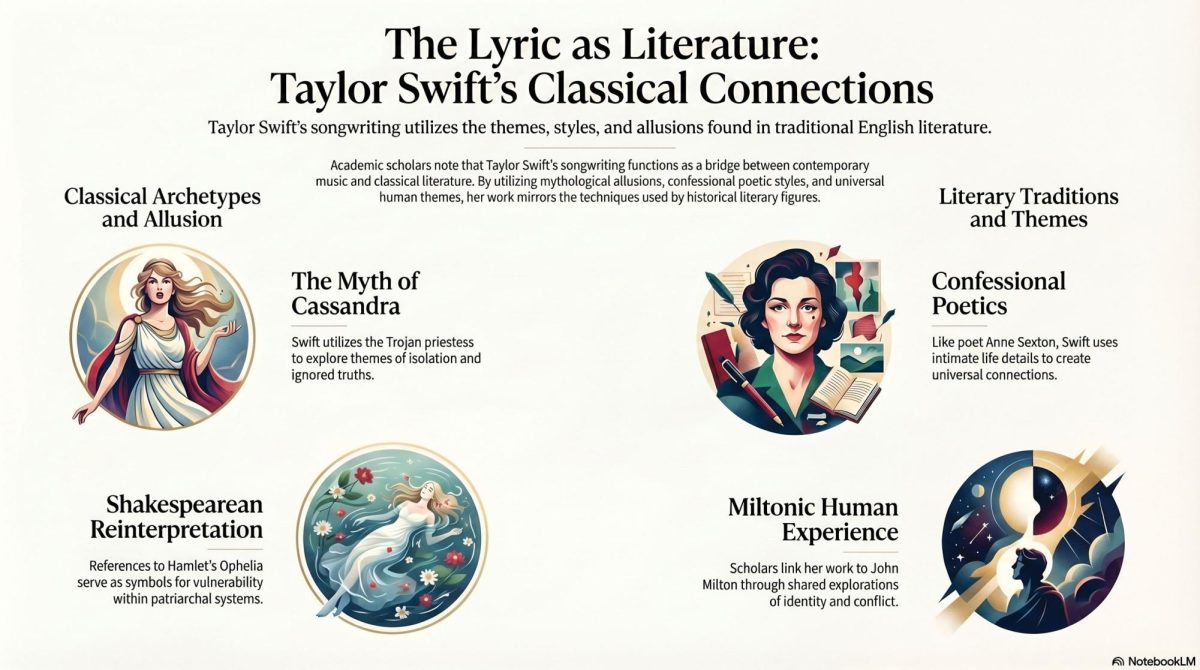
“She reminds me of a confessional poet,” Radek said, referencing writers like Anne Sexton. “She uses details from her own life to create something that shows people they are not alone.”
Radek points to Swift’s use of literary and historical references as evidence of her depth.
In songs like “Cassandra,” Swift draws from mythology, while other lyrics echo figures like Ophelia, a character from William Shakespeare’s “Hamlet,” often interpreted as a symbol of women’s vulnerability within patriarchal systems. “She’s building on those ideas, but she also reshapes them,” Radek said.
Through imagery, symbolism, and narrative voice, Swift’s songwriting mirrors many of the techniques found in traditional literature. For Radek, that overlap makes her work especially relevant in academic settings. Both professors agree that the connection between poetry and music is persistent.
“Music and poetry come from the same place,” Haferkamp said. “There is a lot of crossover.”
Radek shares a similar view. “Songs are one of the earliest forms of poetry,” she said, emphasizing that both forms are rooted in the goal to communicate meaning and emotion.
This shared foundation is what opens the door for artists like Swift to be studied in English courses. While Haferkamp believes the context is important, suggesting lyrics are most appropriate in literature classes, she sees clear value in analyzing them.
“The work of receiving something new is the same,” she said. “The human experience hasn’t changed.” In that sense, Swift’s lyrics can act as a bridge between contemporary and classical literature. By comparing her work to writer John Milton, students may start to recognize shared themes of identity, emotion, and conflict across time.
“It broadens your understanding. You start to see these elements of humanity across different works,” Haferkamp explained.
Both professors stated that while they do not cover Swift lyrics themselves as a topic in class, they allow students to choose literary pieces for some assignments. Additionally, they have several students who use the works of Taylor Swift.
Radek describes Swift as “a very strategically intelligent performer,” whose impact extends beyond music.
Radek emphasizes that relevance plays a major role in student engagement. “Students should be engaging with things that matter to them,” she said. “If they find that in a song, they should be analyzing it with the same skills.”
Ultimately, both professors agree that literature continues to evolve alongside culture.
“It’s easy now to get wrapped up in our own world,” Haferkamp said, “but literature tells us who we are, who we were, and who we’re going to be.”
Radek also mentioned that idea, emphasizing literature’s enduring purpose. “People write in response to what’s going on,” she said. “It helps us navigate our lives and reminds us we’re not alone.”
Whether through centuries-old text or modern songwriting, the goal remains the same, which is to understand the human experience.
In today’s classrooms, that understanding might not just begin with a poem or a mythology story, but with a song.